

What Is Seized Drug Money Used For
A pair of New Mexico businessmen were driving forth Interstate 40 in Oklahoma late one night in April when a sheriff's deputy flipped on his lights and sirens and pulled over their BMW sedan.
The two men, Nang Thai and Weichuan Liu, were on their style to a hotel in Oklahoma City. They planned to catch some sleep earlier heading out in the morning to close on a 10-acre plot of farmland they'd agreed to buy for $100,000.
But at present, at about 2 a.m. on April 19, a Canadian County sheriff'due south deputy was peering into their car.
"We didn't sympathize why he pulled us over," said Thai, 51, a Vietnamese immigrant and father of two from Albuquerque. "I was driving under the speed limit."
They had no way of knowing at the fourth dimension merely Thai and Liu were about to brainstorm an hourslong ordeal that would leave them stripped of all their greenbacks and searching for answers. Their experience highlights the controversial law enforcement practice known as civil asset forfeiture, in which police can confiscate a person's cash or other belongings fifty-fifty without bringing criminal charges.
The deputy asked the two men for their licenses, where they were going and whether they were carrying whatever money, according to Thai.
They had a large corporeality of cash in the vehicle: more than than $100,000, which Thai says they brought to pay for the property. Thai — who speaks English language with a heavy accent (Liu speaks very little English language at all) — told the officeholder they were headed to a hotel and, yes, had cash on them.
The deputy said he suspected they were involved in "illegal activity," according to Thai. A criminal background search would have turned up a 2022 conviction confronting Liu for growing marijuana in California.
After a second officeholder arrived at the scene, the men were driven to a police station and interrogated for hours. Deputies emptied a backpack and suitcase full of greenbacks, then pulled apart the inside of the BMW but patently turned up no guns, drugs or any other illicit items.
Thai said he told his interrogators they had saved upward the money for years and were planning to use the land for farming but hadn't even so adamant which crops to heighten.
"They kept saying, 'This is illegal money,'" Thai said. "I said, 'Okay, show it. We didn't exercise anything illegal.'"
The ii men were released without being charged or fifty-fifty issued a traffic ticket, but the Canadian County Sheriff'southward Office did not return their cash. Court papers filed past District Attorney Michael Fields say the coin was seized because it was intended to be used to violate drug laws or resulted from illegal drug transactions.
The men are at present fighting to get it back. Adding insult to injury, they debate that the amount the sheriff's role says it confiscated – $131,500 – is really $10,000 brusque of the total they had in their car that mean solar day.
"Now I have to prove I'chiliad innocent, and they are the ones who illegally took my money and basically stole some of my money, too," said Thai.
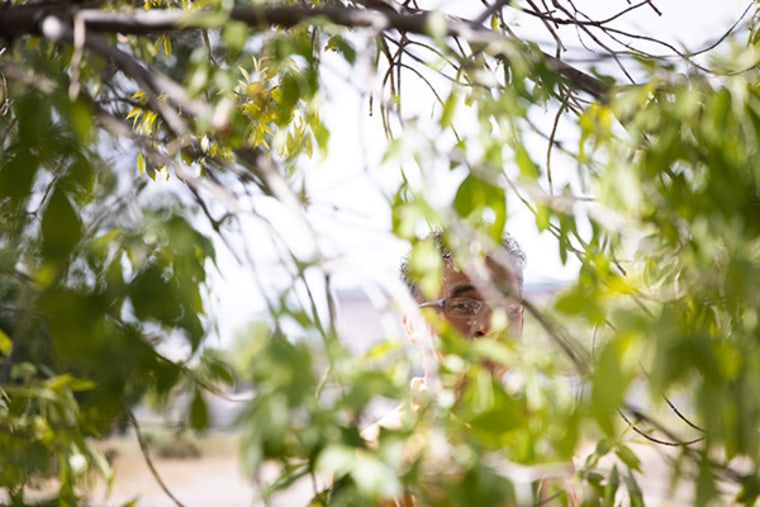
The court docket contains no records detailing the traffic stop or the seizure, and neither the sheriff's part nor the district attorney'due south function agreed to comment.
Among those surprised by the plough of events is the man who was set to sell his country to Thai and Liu.
"I was shocked when I heard of the confiscation of their money," the seller told NBC News.
He said he had met with them a few days before and had drawn upwardly a contract to sell the property to Thai for $100,000. NBC News has viewed a re-create of the understanding.
"They seemed like very nice and intelligent business people," said the seller, who spoke on the condition of anonymity. "I feel bad for them and the situation."
What happened to Thai and Liu is not at all unusual.
Federal and local police force enforcement take broad dominance in many parts of the country to seize a person's holding if it is suspected to be linked to criminal activity. Civil nugget forfeiture allows the authorities to confiscate items like cash and cars even without charging the people forced to give upwardly their holding.
Defenders of the practice say it's a vital tool in fighting drug traffickers, who are known to hide ill-gotten cash in vehicles and other items. But critics across the political spectrum argue that it violates ramble rights and disproportionately impacts minorities and depression-income people who are more probable to be profiled by police and less likely to take the resources to challenge the seizures.
"Billions of dollars are taken yearly from citizens who are never charged with a offense, and are not afforded any of the due process provisions of the Constitution, such as a 24-hour interval in court, presumption of innocence, right to counsel, and an impartial jury," said Brad Cates, former director of the Justice Department's Asset Forfeiture Office during the Reagan Administration who has go an outspoken critic of civil forfeiture.
And then far this year, local law enforcement agencies confiscated more than than $1.iii million from people driving through Canadian County, according to an NBC News review of courtroom records.
At least 58 per centum of the 31 greenbacks seizures involved minorities simply – with Asian people making up 23 percent, Black 19 percent and Hispanic 16 pct. White people accounted for 26 per centum of the forfeitures in Canadian County, which is more than than 75 percent white.
But 14 out of the 31 cash forfeitures resulted in criminal charges, or 45 percent, court records evidence.
In 2022, some 43 per centum of the 53 cash seizures in Canadian County involved minorities. Black people accounted for xviii percentage, Hispanic 17 percent, Asian 7 percent and white 26 percent, co-ordinate to the NBC News review. The cash seizures yielded more than $1.8 one thousand thousand dollars, court records show, and 31 of the 53 resulted in criminal charges, or 58 percentage.
The high per centum of minorities subjected to cash seizures in Canadian County is not a new trend.
The nonprofit investigative news site Oklahoma Watch constitute that 60 percent of the cash seizures in Canadian Canton between 2022 and 2022 involved minorities. Ix other counties in Oklahoma, including the six largest, had roughly the same per centum over that five-twelvemonth time catamenia, according to Oklahoma Lookout man.
Megan Lambert, legal director for the American Civil Liberties Union of Oklahoma, said she found the figures on cash forfeitures and race "in no mode surprising."
"Racism and implicit bias have a greater touch on where discretion is allowed, and law savor a significant amount of discretion over ceremonious asset forfeitures," she said. "The lack of accountability or transparency and the perverse financial incentives of civil asset forfeiture make the process ripe for abuse and bias."
"Highway robbers"
More than xxx states have instituted reforms in recent years to protect people from civil asset forfeiture, such as shifting the burden of proof to the authorities. Others — similar New Mexico, North Carolina, Nebraska and Maine — have abolished it all together.
Just Oklahoma is not among the states to have significant action to curtail the do.
Information technology has among the worst civil forfeiture laws in the country, according to the Constitute for Justice, a Virginia-based public interest law house that releases reports grading state forfeiture laws. Oklahoma earned a D-minus grade in the latest Establish for Justice written report, which cited the low bar for confiscating greenbacks and the large incentive created by the seized money going direct to the law enforcement agencies themselves.
"The regime only has to show by a preponderance of evidence, or more likely than not, the property is connected to illegal activity," said Dan Alban, a senior attorney at the Institute for Justice. "That'south a very low burden of proof. It finer places the burden on the property owner to prove their own innocence."
Canadian County straddles Interstate twoscore, a major drug trafficking corridor that runs from California to the North Carolina coast. The county sheriff'south office and the Oklahoma Highway Patrol devote substantial resources to combating it. Merely civil liberties lawyers and local defense attorneys argue that law enforcement uses the focus on drug interdiction as cover for stopping and searching vehicles on flimsy pretenses.
William Campbell, an Oklahoma Urban center-based defense attorney with expertise challenging civil forfeitures, said in whatever other context the officers, who are known to target cars with out of state license plates, would be seen as "common highway robbers."
"It doesn't matter whether you're innocent or annihilation else," said Campbell. "They're going to do whatever they're going to practise — generally in the dark, on the side of the road in the middle of nowhere — where yous as the citizen are completely at their mercy."
"District attorneys fund their offices with this money," he added. "When the DA is making half a million or more than off of these stops, how tin can they be an honest banker on whether these stops are good? They accept no incentive to stop this."
Canadian County Sheriff Chris W declined to annotate on the apply of civil forfeiture or the example of Liu and Thai. A well-known figure in Oklahoma, Westward faced controversy earlier this year when it emerged that he attended the Jan. 6 rally in Washington protesting onetime President Trump's ballot loss. He said he walked to the Capitol just did not enter the building or participate in mob violence.
Calls to District Chaser Michael Fields' office were referred to the prosecutor handling the case, Mitchell Thrower, who did not answer to a request for comment. At a 2022 hearing for a doomed pecker to reform ceremonious forfeiture laws in Oklahoma, Fields voiced his opposition to legislation that would, amid other things, prohibit forfeiture without a conviction.
"Asset forfeiture is the only tool at our disposal that allows u.s.a. to accept drugs off the streets and profits out of the hands of those who only seek more drugs, more than money and more lives to destroy," Fields said.
Four decades of savings
Thai said he was 16 when he arrived in the U.S. on a gunkhole from Vietnam in 1986. After graduating high schoolhouse in Albuquerque, he attended community college and then worked at Intel for xvi years as a technical engineer and information analyst. He went on to open and run a restaurant, the Asian Grill, until 2022.
Thai says he saved a chunk of money over the years and largely eschewed banks. "In my civilisation, nosotros apply greenbacks," he said.
Seeking a prophylactic investment, he said he began studying vertical farming, which involves growing crops in vertical stacks using hydroponics, and looking around for a cheap piece of country to purchase. He establish a partner in Liu, who he met through the Albuquerque restaurant scene.
"You never lose money if y'all buy a piece of subcontract land," Thai said. "That's why Neb Gates bought then much land."
Thai said he told the officers who grilled him that they had worked difficult for their money and had no firm plans on what they were going to do with the land.
"He kept asking where did the coin come from? Where did I work?" Thai said. "I said, 'I lived here a long fourth dimension. I worked many years.'"
After the interrogations were over and the deputies allow the men go, they received no paperwork related to the forfeiture, Thai said. Campbell, the local defense lawyer not involved in the case, said police force enforcement is supposed to consequence holding receipts detailing what was seized simply doesn't ever do then.
The Canadian County Commune Attorney filed a observe of forfeiture on April 22, which gave Thai and Liu 45 days to file a claim to the greenbacks. Their attorney responded on May 10, denying that the money was continued to drug activity and asserting that the forfeiture violated their Fourth Amendment rights.
The lawyer for Thai and Liu, Richard Anderson, did not respond to requests for comment.
Through a translator, Liu declined to comment.
He was arrested in June 2022 afterward police constitute more than 600 marijuana plants at a house he was staying in with two others in Stockton, Calif. Liu, now 45, pleaded guilty to a misdemeanor count of cultivating marijuana and served 30 days in the canton jail, said a spokeswoman for the San Joaquin County District Attorney'south Role.
In the days after the Oklahoma traffic finish, a Canadian County prosecutor suggested to a local newspaper that the cash seizure was based on their intention to grow marijuana.
Oklahoma legalized medical marijuana in 2022. Nether state law, at least 75 percent of a medical marijuana business must exist owned by an Oklahoma resident for information technology to exist licensed.
"An out-of-country person, for example, can't come to Oklahoma and kickoff their ain marijuana farm," Canadian County Banana District Chaser Eric Epplin told the Yukon Progress, speaking generally most the example. "You have to be a resident of the state."
The regulation allows for someone to motility to the state and employ for a license after two years.
Thai said he was aware of the licensing requirements only insisted that they weren't set up on growing cannabis.
"That'south their narrative that they're using against us," he said of the police and prosecutors.
"We saw it equally a good investment," he added. "We didn't know yet what we were going to practice. It could be annihilation — it could be marijuana, information technology could be something else."
James Todd, an Oklahoma City defense lawyer who is not involved in the case, said he thinks prosecutors may have a tough time proving the men intended to utilize the country to outset an illegal drug operation.
"I don't see in this example annihilation other than a 'he said, she said' state of affairs, where the state says they intended to grow marijuana without a license and the men say no they weren't," said Todd, who worked as a detective and land prosecutor in Oklahoma before becoming a defence attorney.
A pre-trial court hearing has been set for Oct. twenty. Thai, meanwhile, has set his sights on a new venture closer to home: a bubble tea shop in Albuquerque.
"I've been living hither since 1986 and worked difficult for 4 decades," Thai said. "I just desire my money back."

Source: https://www.nbcnews.com/news/us-news/highway-robbers-how-trip-buy-farmland-ended-police-taking-all-n1281629
Posted by: floodclooke.blogspot.com
0 Response to "What Is Seized Drug Money Used For"
Post a Comment