

Intel Core i5-10400 vs. AMD Ryzen 5 3600
Intel's new Core i5-10400 is a locked 6-cadre, 12-thread processor that operates at between two.9 GHz and 4.3 GHz depending on the workload. The reason the base clock is and then low relative to the i5-10600K is that the TDP rating has dropped from 125 watts down to just 65 watts. However, the vast majority of Z490 motherboards don't enforce the TDP limits.
We've had access to several new Z490 boards and only Asus seems to adhere to these limits with MSI, Asrock and Gigabyte all running without ability limits with only one or 2 exceptions on mATX and Mini-ITX boards. That being the instance, the typical out of the both experience won't be power limited and therefore we'll be testing the Core i5-10400 on a Z490 board with no TDP restrictions in identify.
Since this is a locked part, we'll include a DDR4-2666 retention configuration equally that is the maximum memory speed you'll get access to B and H-series motherboards.

Intel's suggested tray cost for this chip is $182. In that location's also the 10400F variant of this chip that lacks integrated graphics for $157. Those prices may accommodate in the coming weeks based on need and how users perceive the 10400 to perform against the Ryzen 5 3600 which is usually sold around $175. So when information technology comes to pricing AMD is asking virtually the aforementioned kind of money for their base model vi-core, 12-thread processor, which does not take integrated graphics merely comes unlocked and supports retentivity overclocking on all motherboards.

It appears as though Intel'southward already on the dorsum foot against a tough rival, but nosotros should probably take a look at the benchmark results before drawing whatsoever conclusions.
The Ryzen processors were tested on the Gigabyte X570 Aorus Master, 8th and ninth-gen Cadre processors were tested on the Gigabyte Z390 Aorus Ultra and the new 10th-gen Intel processors on the Asus ROG Maximus XII Extreme. All configs were tested with a GeForce RTX 2080 Ti, 32GB of DDR4-3200 CL14 retention and a Corsair Hydro H150i Pro 360mm AIO liquid cooler.

As noted earlier, the Core i5-10400 was tested with both DDR4-3200 and DDR4-2666 retentiveness, using the same CL14 timings. Our examination suite has been shortened on this review compared to the final few, having spent the last week looking at in-depth testing for the 10900K, 10700K and 10600K, we only don't think the 10400 warrants us going over 30+ tests and you should exist able to draw the aforementioned kind of conclusions regardless. With that said, we've picked key application and game benchmarks to look at, so here we go.
Benchmarks
Cinebench R20 multi-core goes first and right off the bat we run across that memory speed doesn't impact these rendering workloads equally the Core i5-10400 produces basically the same result using either DDR4-3200 or 2666 memory.

With merely shy of 3200 points, the 10400 was fifteen% slower than the Ryzen 5 3600 and that doesn't bode well for the Intel processors application performance. Moreover, it was xiv% faster than the Ryzen 5 1600 AF... too bad that part is no longer as inexpensive as used to, but yet good for around $110.

When it comes to single core performance, we see that at least in Cinebench the memory speed doesn't play much of a role. Ryzen 5 3600 was ~13% faster hither and the 10400 comes in behind even the Ryzen 3 3100.

Moving over to 7-null and hither we're looking at a 5% performance heave for the 10400 when using the faster spec memory. Granted a 5% increase is pretty small for a twenty% boost in memory frequency, but notwithstanding that'southward more that what nosotros saw in Cinebench. When using the same memory every bit the Ryzen 5 3600 the 10400 was 8% slower for compression work and then 12% slower with DDR4-2666 retentivity.

The margin widens when it comes to decompression performance and here the 10400 was at least 22% slower than the 3600. In fact, the 10400 was slower than fifty-fifty the 1600 AF.
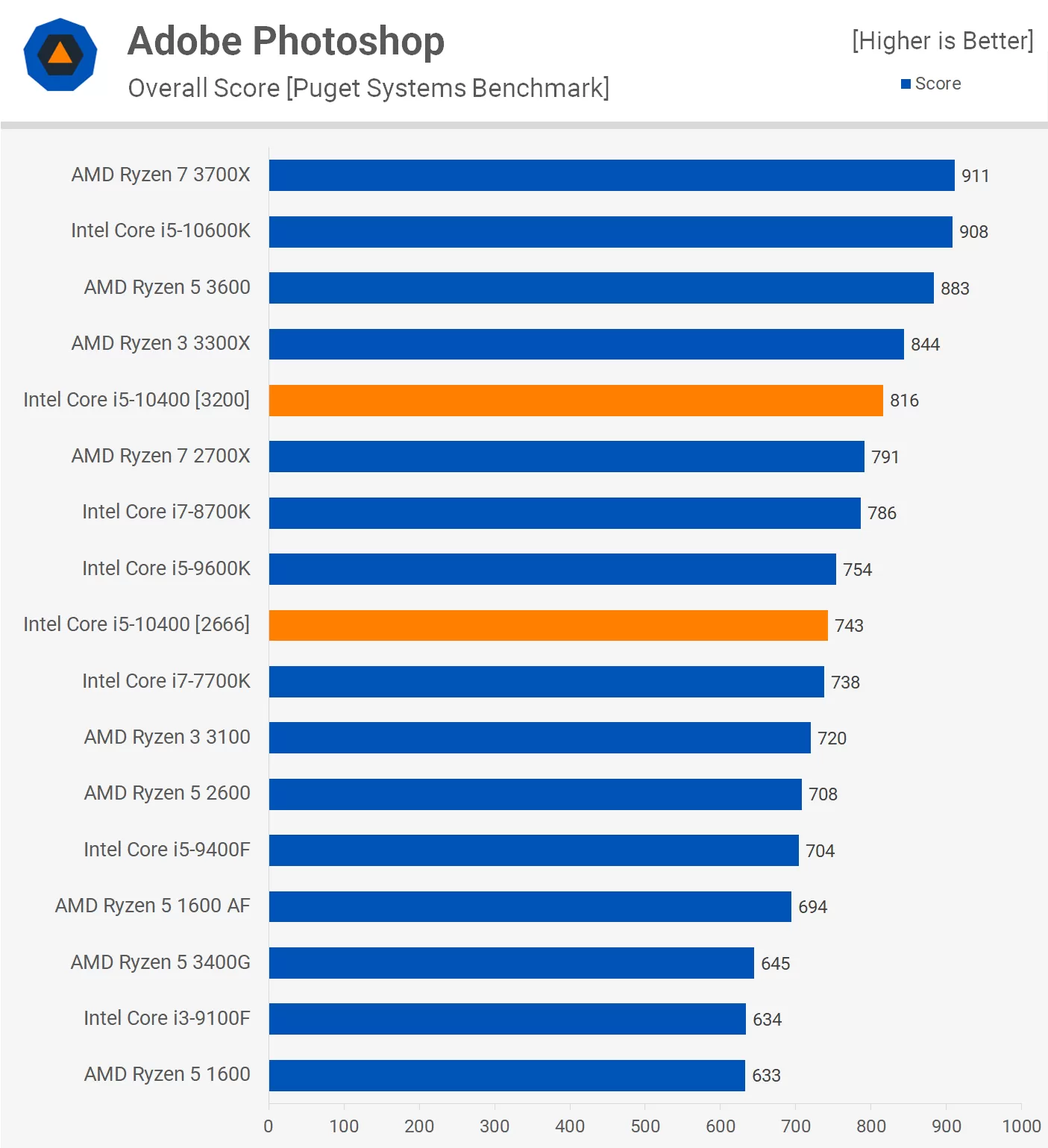
Next up we take Adobe Photoshop which prefers single core operation and interestingly we do run across a x% performance uplift for the i5-10400 when using DDR4-3200 memory over DDR4-2666, so that's meaning.
It also ways while the Ryzen v 3600 is viii% faster than the 10400 when using the same speed retention, when forcing the 10400 to run at the 2666 spec on B or H-series boards the 3600 is a whopping nineteen% faster in the Puget Systems Photoshop benchmark.

Moving over to DaVinci Resolve Studio sixteen, we come across the faster memory has fiddling influence on functioning. When comparing the DDR4-3200 configurations the Ryzen 5 3600 was however eight% faster, not a massive margin but for a CPU that generally costs less, that'due south a good upshot for AMD.

Wrapping up the application testing with Blender nosotros notice that the Ryzen 5 3600 is 8% faster than the 10400 when using DDR4-3200 and 10% faster when using DDR4-266 memory.

When looking at power consumption we find that while the Ryzen 5 3600 isn't miles better than the 10400, it does consume roughly the same amount of power for effectually 10% better performance.
Gaming Benchmarks


Battlefield V shows the Core i5-10400 performing very well in games, and with the same-spec retentivity it roughly matches the Cadre i7-8700K, making it around v% faster than the 3600 when comparison the average frame rate. However, when paired with a B or H-serial lath, the 10400 volition match the 3600 in this title.
Jumping up to 1440p reduces the margins for the nigh part and the 10400 performs roughly the same using either DDR4-2666 or 3200 memory.


Far Cry New Dawn typically shows u.s. a worst instance scenario for Ryzen, yet the 10400 is shown to lucifer the 3600 here when using the same DDR4-3200 retentivity. Using DDR4-2666 sees the 10400 sideslip a piddling behind simply simply barely.
Moving to 1440p sees the margins remain much the same and information technology would be impossible to tell the deviation between the 10400 and 3600, fifty-fifty when using slower DDR4-2666 memory.
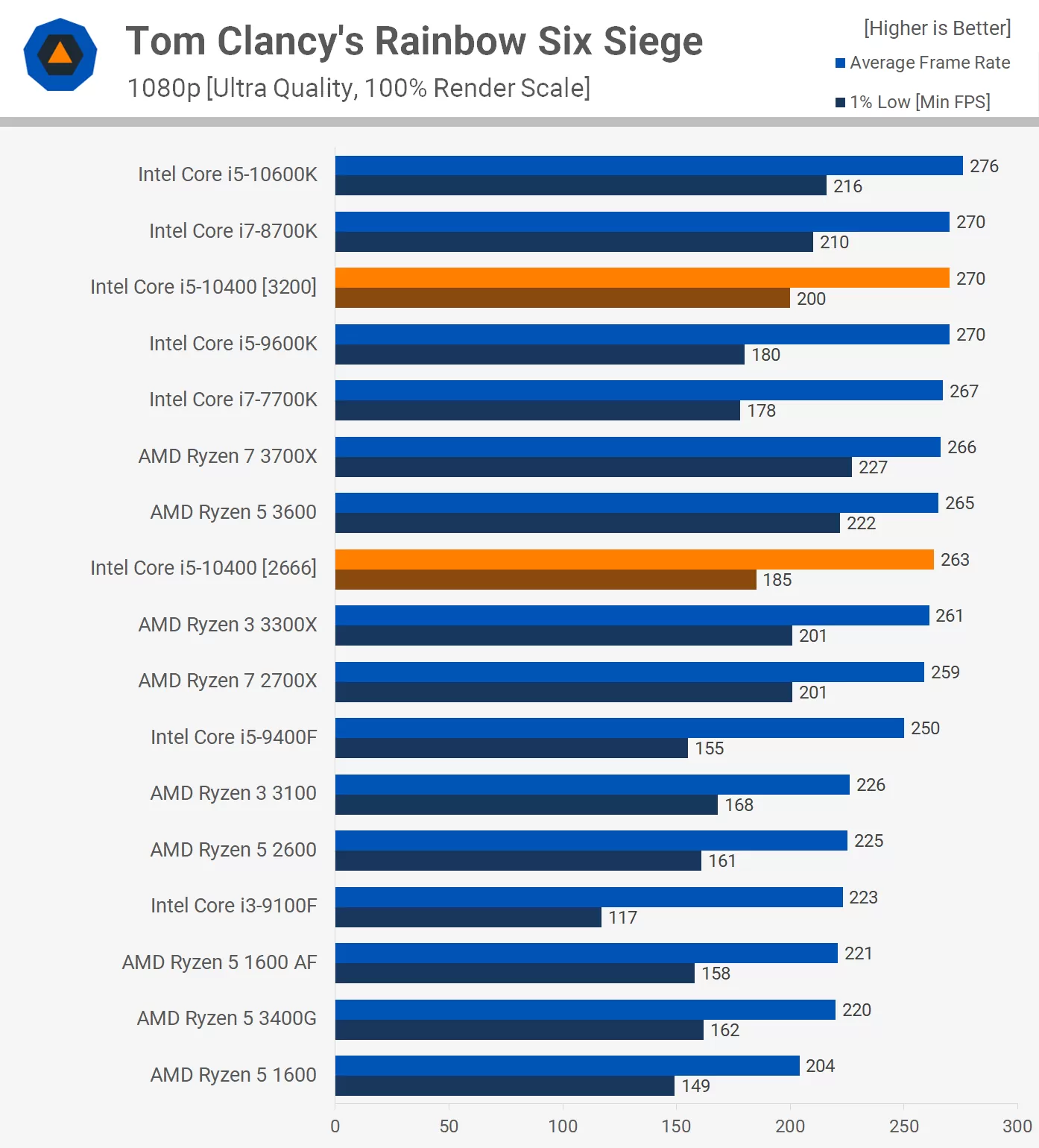

The Ryzen 5 3600 performs very well in Rainbow Six Siege, particularly when looking at the one% depression result. Here it was 11% faster than the Core i5-10400 and 20% faster when comparing the Intel processor with DDR4-2666 memory. It'south of import to notation that worst instance the Intel CPU was still spitting out over 180 fps at all times in our exam, so how much that 20% margin matters here is debatable.
Moreover, when jumping upward to 1440p which we feel is a more than realistic scenario with an RTX 2080 Ti, the 10400 and 3600 are indistinguishable in terms of gaming experience. We're also looking at nigh no difference between the DDR4-2666 and 3200 configurations.

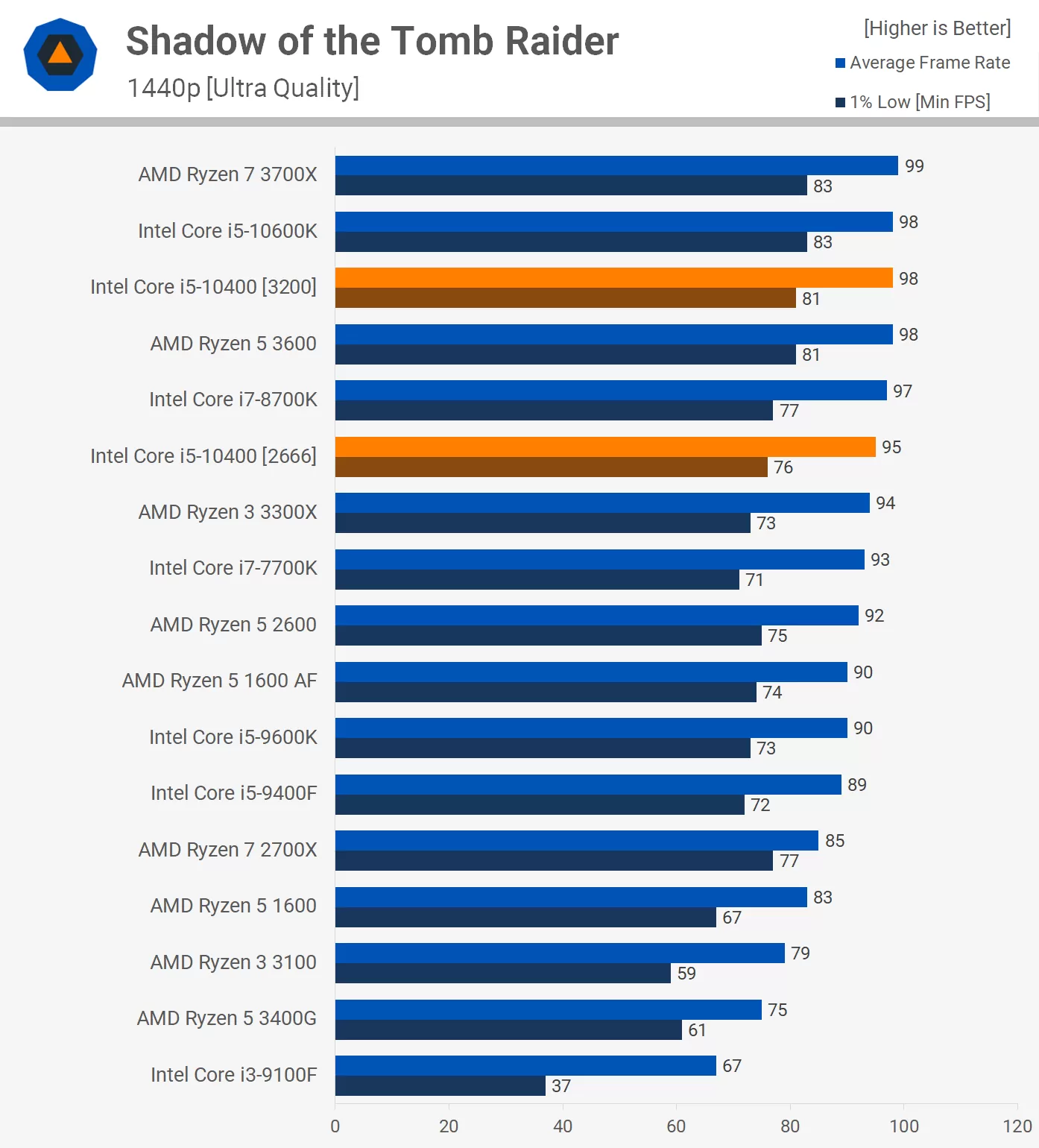
We see a rather pregnant difference in Shadow of the Tomb Raider performance when comparing DDR4-3200 and 2666. Here the faster retentiveness spec boosted the average frame rate past 11% and the 1% low figure by 13%.
As noted in the by, Shadow of the Tomb Raider is very CPU demanding, particularly the open up world section nosotros use for testing and on that annotation, just to be clear, these results haven't been recorded using the congenital-in criterion which we feel isn't CPU demanding plenty and not a fully reliable way to exam this championship. Instead we're using OCAT to measure in-game performance at a later section of the game, about iv-5 hours into the campaign.
Shadow of the Tomb Raider is probably the most CPU demanding title we test with, information technology'due south certainly right up there with Battlefield 5. Then it's interesting to not only see a large departure betwixt the DDR4 memory configurations, merely to also come across the Ryzen 5 3600 abaft the Core i5-10400 by a 4% margin and beating it when using DDR4-2666.
Granted, as nosotros move to 1440p the results go far more GPU bound and equally a result the 3600 and 10400 deliver identical functioning when both are configured with DDR4-3200 memory. Moreover, the 2666 configuration is now just three% slower when comparing the average frame rate.
What We Learned
Is the Core i5-10400 worth the $182 asking toll? Probably not, but hey, it'south competing confronting the extremely ambitious and awesome Ryzen 3600.
In our opinion, the key outcome for Intel is AMD's aggressive pricing. Although the Ryzen 5 3600 should be the slightly more expensive CPU at ~$200, for the past few weeks information technology's been selling for simply $175 (or fifty-fifty less, as of writing).
Every bit y'all simply witnessed, when it comes to gaming operation the Core i5 processor is roughly on par with the 3600, while for productivity tasks AMD'south offering is ofttimes up to 10% faster while consuming a similar level of power. If y'all will exist adding a graphics bill of fare to your build, then the slightly less expensive i5-10400F should prove a meliorate value. Thus, you could debate the price difference betwixt the AMD and Intel processors is a launder.

But when you lot factor in the platform and board cost, it's a bleaker pic for Intel. A decent Z490 board like the Tomahawk will prepare you back $190, whereas the B450 Tomahawk costs just $115 -- a $75 cost disparity. Both CPUs come with box coolers and neither is particularly impressive. Just with a good motherboard, the i5-10400 volition end up costing more than if you lot want to accept advantage of faster memory. There are cheaper $150 Z490 motherboards but they're encarmine atrocious, with weak VRMs and lackluster feature sets, you 100% shouldn't buy them.
Bold decent Intel B460 motherboards tin match the B450 Tomahawk in terms of quality and features, that'll see the 10400 toll nearly the aforementioned equally a Ryzen 3600 rig but limited to DDR4-2666 memory, where it was typically slower than the 3600 in games, and up to 20% slower in applications.

All in all, the Core i5-10400 is a expert CPU, it just has information technology tough competing with the Ryzen 5 3600 which is a better value pick for most. If you happen to end up with a 10400, you'll be happy with the functioning.
As for what the immediate futurity holds, we'd bet the Ryzen 5 3600 volition go along selling for $175 or even less, with rumors of a additional 3600XT coming soon. For Intel to compete in terms of value, it will need to drop the i5-10400 down to ~$150 and of course upcoming Intel B460 boards volition have to prove their worth also. Opening upwards memory overclocking would certainly help Intel's case likewise, this is something they absolutely need to do at this point.
Shopping Shortcuts:
- Intel Cadre i5-10400 on Amazon
- AMD Ryzen five 3600 on Amazon
- Intel Cadre i5-10600K on Amazon
- Intel Core i7-10700K on Amazon
- Intel Core i9-10900K on Amazon
- AMD Ryzen 7 3700X on Amazon
- AMD Ryzen 9 3900X on Amazon
- GeForce RTX 2080 Ti on Amazon
- GeForce RTX 2060 Super on Amazon

Source: https://www.techspot.com/review/2032-intel-core-i5-10400/
Posted by: floodclooke.blogspot.com
0 Response to "Intel Core i5-10400 vs. AMD Ryzen 5 3600"
Post a Comment